
News
Announcements
-
19.08.2026Acorn Robot Secures Angel Funding Led by NIO Capital, Unveils ‘Instinctive’ AI Model
-
17.08.2026NIO Capital Backs Shifang Technology in RMB 300M Financing as Digital Inkjet Printing Expands Beyond EV Batteries
-
13.07.2026NIO Capital Celebrates Dual IPO Milestone as Portfolio Companies Momenta and EACON List on HKEX on the Same Day
Announcements
30.09.2026
Vision to the Unseen: NIO Capital's AGM 2026 Maps the Next Industrial Frontier
Frontier technology innovation, future industry trends and investment strategy topped the agenda as nearly 200 investors, industry experts and entrepreneurs from the NIO Capital ecosystem gathered for the firm's 2026 Annual General Meeting (AGM). The event packed two keynote speeches, two expert sessions, three industry roundtables and an exhibition by nine portfolio companies into its program.
In his opening keynote, William Li, Founder, Chairman and CEO of NIO and Managing Partner of NIO Capital, offered guests from around the world his frontline read on the smart EV sector. New energy vehicles reached 65.2% penetration of China's new car market in August, with battery-electric vehicles accounting for 69.5% of that segment — making pure electric the dominant powertrain for the first time. Li expects NEV penetration to exceed 90% by 2030, with BEVs taking more than 90% of the NEV market. NIO, he said, has now entered its third phase of quality growth.
"Today's automotive industry is being transformed by three industries at once: intelligence, energy and the car itself," Li said. "Our team, myself included, sits on the front line of the industry, identifying technological shifts and industry direction — and that lets us genuinely help the companies we back move from technology validation to scale, and into real industrial deployment."
"We know very well that it takes a long time for a technology to go from frontier innovation to actually creating value, and there will be ups and downs. So how do we better integrate technological and industrial innovation? We hope to power up together with all of you."
Founded in 2016, NIO Capital is marking its tenth year in venture capital, with more than 100 investments and 15 IPOs to date. Behind that steady record is a philosophy that has held through every shift in trend and cycle. Managing Partner Ian Zhu said it comes down to three principles: discern tech trends, anchor to business essence, and surface use-case value.
In Zhu's view, China's industrial narrative has shifted dramatically, with the center of gravity pivoting toward original innovation, upgrading along three themes: moving upmarket, going intelligent and going green. He offered four judgments on investment themes for the next two to three years.
First, AI is reaching higher while diffusing into the physical world. Large language models have already been deeply trained on data accumulated across human history, but AI still lacks real-world data as it moves into the physical realm, and models must keep pushing upward. At the same time, AI's entry into the physical world will lead to intelligent hardware in many forms — and supply chain opportunities behind them.
Second, innovation is driving infrastructure upgrades. On one hand, computing power as AI infrastructure must break through limits such as the memory wall and communication wall with next-generation architectures. On the other, surging energy demand from AI data centers has brought nuclear power back into focus, while renewable energy is set for explosive growth to replace fossil fuels.
Third, frontier technologies are accelerating. Investors have growing confidence in China's original technology and are actively deploying across different fund categories — for projects in the commercial validation stage as well as those still validating their technology.
Fourth, global supply chains continue to evolve. Excellent companies still want to compete internationally and are stepping up overseas expansion.
Closing his speech, Zhu addressed the mixed emotions AI is stirring in society — anticipation and fear alike. "Humanity confronting the challenge of machines is not a new event," Zhu said, quoting American behavioral psychologist B.F. Skinner in 1969: "The real question is not whether machines think but whether men do."
Energy: From Fusion Breakthroughs to the Commercialization Threshold
Judgments about future industries became the shared starting point for the three industry discussions that followed.
Yuntao Song, Director of the Institute of Plasma Physics at the Chinese Academy of Sciences, traced China's long accumulation in fusion research — from building EAST, the world's first fully superconducting tokamak, to BEST (Burning Plasma Experimental Superconducting Tokamak), now under construction. Fusion energy, he said, is advancing step by step from scientific experiment to engineering validation, gradually forming an advanced industrial cluster spanning upstream materials, midstream equipment and downstream construction and operations. The significance of fusion energy is therefore no longer confined to "a future power plant" — it is beginning to extend into an industrial ecosystem.
After the session, NIO Capital Partner Carl Guan held a brief exchange with Song that naturally led into the first roundtable: Power & AI. The reopening of the energy sector's renewed appeal is inseparable from AI's rise. Guan then moderated a discussion with Zeguang Li, Founder and Chief Scientist of AND; Zhiyong Hong, Vice Chairman of Shanghai Superconductor Technology; and Nie Lin, General Manager of Sunup Fusion, on the industrialization pathways for fission and fusion.
In the landscape the panel described, high-temperature superconducting tape performance has doubled and costs have dropped to one third of their former level over the past five years, and global demand for tape from fusion devices is expected to leave roughly RMB 10 billion of headroom by 2030. At the same time, the industry is undergoing rapid price declines and supply chain reshuffling, with the next 12 to 18 months likely to mark an important phase of further differentiation among suppliers.
From research devices to key materials, from engineering capability to supply chain coordination, the discussion ultimately landed on the question everyone cared about: how far is fusion from true commercialization? As for when "the first commercial kilowatt-hour" will arrive, the panel's judgments clustered between 2030 and 2033.
When fusion energy — long discussed on a timescale of decades — begins to be placed on a more definite industrial timetable, what it represents may be not just an energy technology breakthrough, but the starting point of a new industry moving toward reality.
Physical AI: From Model Capability to Real-World Scale
Compared with energy's long cycle, embodied intelligence — the flagship of Physical AI — is approaching its industry inflection point at a very different speed.
In the Physical AI roundtable, NIO Capital Partner Yao Li was joined by Wenbin Tang, Founder and CEO of Dexmal; Alex Xia, Founder and CEO of Xynova; Jianyong Zhang, Co-founder of Huixi Technology (Rhino); and Jing Li, Chief Strategy Officer of Stepfun. One core question ran throughout: should embodied intelligence pursue vertical integration first, or commit firmly to general-purpose generalization models?
The panel did not stop at an either-or. Instead, guests framed it as "wanting both": models must firmly follow the general-purpose generalization route, but must also be scenario-driven — real-world scenarios are the foundation on which models keep learning, iterating and forming a commercial closed loop. Technological capability must ultimately return to the real world: can a robot work reliably, be deployed at scale, and create value continuously? Leaderboard performance, generalization ability, mass production capability and metrics such as DAR (Daily Active Robots) thus become different lenses for assessing a company's true strength in embodied intelligence.
On the industry inflection point, the panel's judgments were closely aligned: the next two to three years may be the critical window for embodied intelligence to reach genuine large-scale deployment.
Computing Infrastructure: AI Demand Is Redefining the Supply Chain
As models grow larger and intelligence extends into the physical world, another change is unfolding at the foundation. AI's demands on computing infrastructure are being continuously restructured.
NIO Capital Partner Adair Lyu was joined by Qiyang Xiao, Founder and CEO of JaguarMicro; Danyu Zhang, CEO of Genitech Technology; and Allen Lee, Chairman of the Technology Strategy Committee at Biren Technology, for a discussion spanning network communications and computing chips. One keyword came up repeatedly: memory.
Rising storage prices mean cost pressure on one hand, but on the other they are an important signal of real AI demand. As model training and inference keep expanding, computing demand is no longer a simple linear matter of "more chips" — it is driving simultaneous upgrades across computing, storage, networking and the software-hardware ecosystem.
The panel's discussion also pointed to two rapidly growing sources of demand: Agentic AI, especially coding scenarios, and Physical AI, including autonomous driving and embodied intelligence.
Against that backdrop, supply chain autonomy and controllability, software-hardware collaboration and ecosystem building have become shared priorities for these companies over the next year or two. The next stage of computing competition may hinge less on single-point performance and more on whether a complete, efficient and sustainably evolving infrastructure capability can be built.
Seeing, Vision and the Unseen
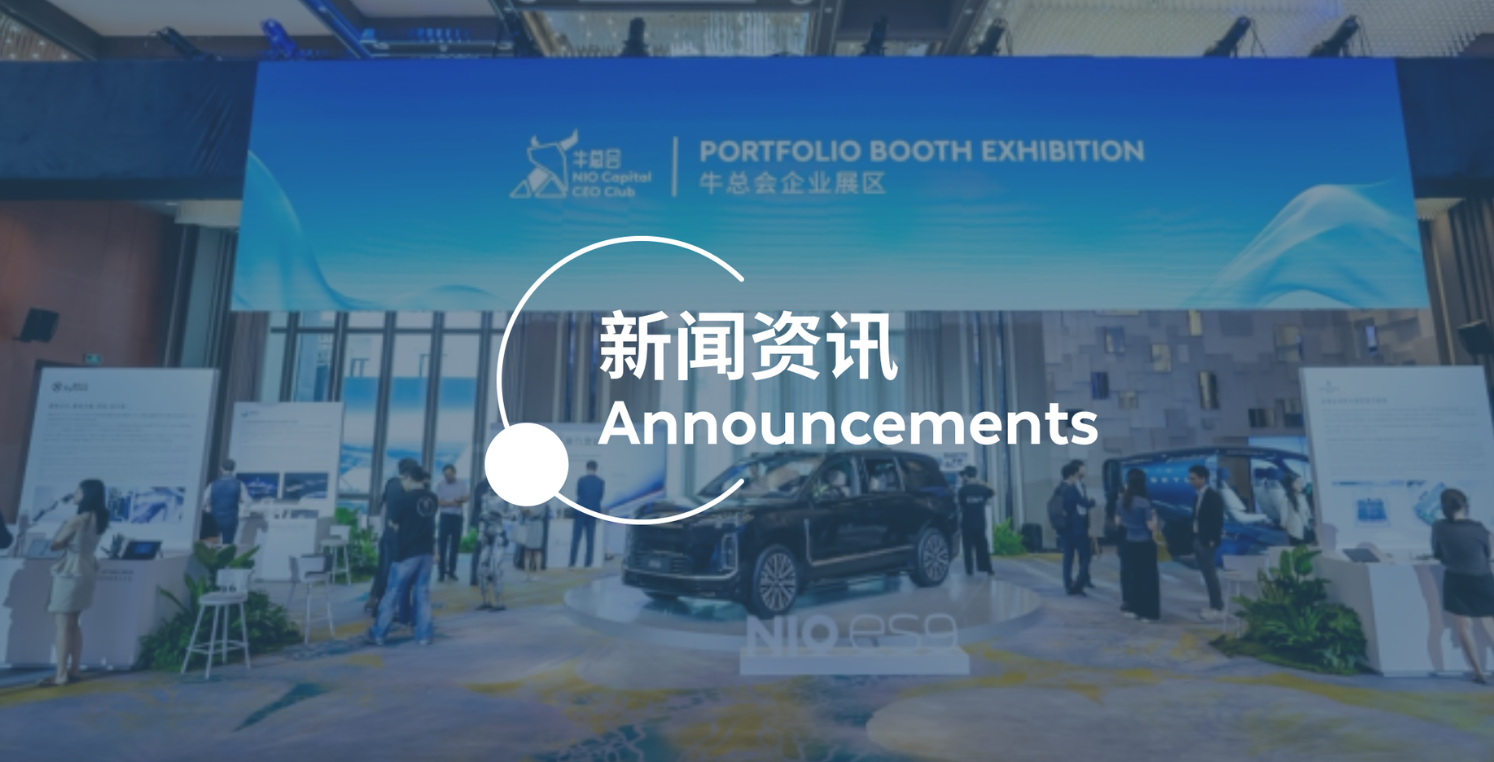
At this year's conference, nine NIO Capital portfolio companies mounted an interactive exhibition spanning computing power, energy, embodied intelligence and eVTOL, giving investors a picture of a future industry already visibly taking shape.
The following day, investors visited Biren Technology and Sudo Technology for on-site tours, once again experiencing up close the frontier development of domestic intelligent computing chips and embodied robots.
The two days of conversations spanned technologies already in large-scale application, industries just standing at the threshold of commercialization, and futures still needing five, ten or even more years to validate.
Yet they are pointing toward an increasingly clear common direction:
Intelligence is reaching higher and diffusing into the real world; energy and computing power are becoming the infrastructure for the next technological leap; and technologies that once lived only in laboratories, papers and demos are stepping into factories, cars, robots and real supply chains.
From the delivery curve of new energy vehicles to the superconducting magnets inside fusion devices; from embodied robots working continuously to the growing AI demand behind memory prices — the "unseen" is not a distant future.
It has often already appeared, in some form, today.
As this year's AGM theme puts it: Vision to the Unseen. What's worth watching isn't the consensus — it's what hasn't become consensus yet, but has already begun.
Announcements
-
19.08.2026Acorn Robot Secures Angel Funding Led by NIO Capital, Unveils ‘Instinctive’ AI Model
-
17.08.2026NIO Capital Backs Shifang Technology in RMB 300M Financing as Digital Inkjet Printing Expands Beyond EV Batteries
-
13.07.2026NIO Capital Celebrates Dual IPO Milestone as Portfolio Companies Momenta and EACON List on HKEX on the Same Day
Subscribe to our newsletter


