
News
Announcements
-
30.09.2026Vision to the Unseen: NIO Capital's AGM 2026 Maps the Next Industrial Frontier
-
19.08.2026Acorn Robot Secures Angel Funding Led by NIO Capital, Unveils ‘Instinctive’ AI Model
-
17.08.2026NIO Capital Backs Shifang Technology in RMB 300M Financing as Digital Inkjet Printing Expands Beyond EV Batteries
Announcements
11.09.2025
NIO Capital’s Mission Blue Advances to Qinghai’s to Protect Plateau Ecosystem
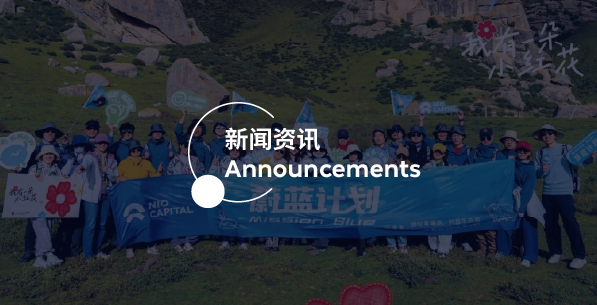
NIO Capital’s “Mission Blue” public welfare initiative recently launched its fourth phase. Continuing its collaboration with Tencent Charity’s “Long-term Charity Festival,” the team entered Qinghai’s Auspicious Eight Treasures Valley to help protect the plateau’s ecological barrier.
Building on the footprints of the first three phases—“Ocean Conservation,” “Afforestation,” and “Desertification Control”—the initiative has progressively reached higher grounds: from coastlines to valleys, to deserts, and now to the Qinghai–Tibet Plateau. Mission Blue continues to expand across ecological gradients, bringing tangible environmental action to diverse ecosystems worldwide. The program aims not only to restore ecological health in each location but also to immerse participants in pristine natural environments and local cultures, fostering reflection on the relationship between humanity and nature, the importance of sustainable development, and NIO Capital’s vision: “Nurture & Enrich Our Planet.”

Mission Blue serves as the banner for NIO Capital’s ESG practice. Designed to turn “concepts” into “experiences,” it helps more people understand sustainability and provides enduring motivation to act on it. The name reflects both NIO’s mission, “Blue Sky Coming,” and NIO Capital’s aspiration that through hands-on participation, individuals can personally grasp the importance of environmental stewardship and contribute to a sustainable future at both individual and collective levels.
Why Focus on Plateau Ecology?

Qinghai is known as the "Water Tower of China," serving as the source of the Yangtze, Yellow, and Lancang Rivers and acting as a vital strategic buffer for the country’s ecological security. The Auspicious Eight Treasures Valley, a representative ecological zone on the Qinghai–Tibet Plateau, features a unique geography and rich biodiversity—yet it remains highly vulnerable amid global climate change.
The fragility of plateau ecology often reveals itself in the smallest details: a plastic bag, a discarded water bottle, or a stray wrapper—items that may linger for decades—can cause irreversible harm to the delicate soil and rare native species. Protecting this pristine land starts with the simplest of acts: picking up trash. Each piece collected is a step toward preservation, a small but meaningful contribution.
Mission Blue
Nurture & Enrich Our Planet

From sea level to high plateaus, from tropical oceans to arid deserts, Mission Blue continues to honor its pledge to "protect the planet, enrich the future." Across the vast Tibetan Plateau, a set of elegant and mystical symbols—the Eight Auspicious Symbols—can be found everywhere: from grand temple murals to household doors, clothing, and everyday objects.
As explained by local Tibetans, these eight treasures—the parasol, golden fish, treasure vase, lotus, white conch, endless knot, victory banner, and golden wheel—are not merely artistic motifs. They embody profound Tibetan Buddhist philosophy and express the people’s aspirations for happiness, wisdom, and fulfillment.
In the Auspicious Eight Treasures Valley, eight distinct peaks correspond to these eight symbols. Trekking through this landscape deepened the team’s awareness of the urgency to protect the Earth. Every time they bent down to remove a piece of litter, they expressed reverence for nature—like turning the golden wheel of good deeds, helping restore the valley to the lotus-like purity it deserves, and spreading the symbolic "far-reaching sound of the Dharma" represented by the white conch. In the context of Tibetan culture, this is more than just cleanup work; it is a form of environmental meditation, an offering to nature.
As Mission Blue has always believed: everyone has the opportunity—and the responsibility—to contribute to a sustainable future for the planet. However small the action, together they can drive real change.
Announcements
-
30.09.2026Vision to the Unseen: NIO Capital's AGM 2026 Maps the Next Industrial Frontier
-
19.08.2026Acorn Robot Secures Angel Funding Led by NIO Capital, Unveils ‘Instinctive’ AI Model
-
17.08.2026NIO Capital Backs Shifang Technology in RMB 300M Financing as Digital Inkjet Printing Expands Beyond EV Batteries
Subscribe to our newsletter


